Frequently Asked Questions
Abreviations
| Term | Full Form |
|---|---|
| DT | Digital Twin |
| DTaaS | Digital Twin as a Service |
| PT | Physical Twin |
General Questions
What is the DTaaS platform?
The DTaaS platform is a software platform on which digital twins can be created and executed. The features page provides an overview of the capabilities available in DTaaS.
What is the scope and current capabilities of the DTaaS platform?
- DTaaS is a web-based interface that allows invocation of various tools related to work to be performed with one or more DTs.
- DTaaS permits users to run DTs in their private workspaces. These user workspaces are based on the Ubuntu 20.04 Operating system.
- DTaaS can help create reusable DT assets only if DT asset authoring tools can operate in the Ubuntu 20.04 xfce desktop environment.
- DTs are executables from the DTaaS platform perspective. Users are not constrained to work with DTs in a specific manner. DTaaS suggests creation of DTs from reusable assets and provides a suggestive structure for DTs. The examples provide more insight into the DTaaS workflow. However, this suggested workflow is not mandatory.
- DTs can be run as services with REST API from within user workspaces, which can facilitate service-level DT composition.
What can not be done inside the DTaaS platform?
- DTaaS as such does not help install DTs obtained from external sources.
- The current user interface of the DTaaS web application is heavily reliant on the use of Jupyter Lab and Notebook. The Digital Twins page has Create / Execute / Analyze sections, but all point to Jupyter Lab web interface. The functionality of these pages is still under development.
Is there any fundamental difference between commercial solutions like Ansys Twin Builder and the DTaaS platform?
Commercial DT platforms like Ansys Twin Builder provide tight integration between models, simulation and sensors. This leads to fewer choices in DT design and implementation. In addition, there is a limitation of vendor lockin. On the other hand, DTaas lets users separate DT into reusable assets and combine these assets in a flexible way.
Do you provide licensed software like Matlab?
Proprietary and commercially licensed software is not available by default on the software platform. However, users have private workspaces based on a Linux xfce Desktop environment. Users can install proprietary and commercially licensed software in their workspaces. A screencast demonstrates using Matlab Simulink within the DTaaS platform. Licensed software installed by one user is not available to other users.
Digital Twin Assets
Can the DTaaS platform be used to create new DT assets?
The core feature of DTaaS software is to help users
create DTs from assets already available in the library.
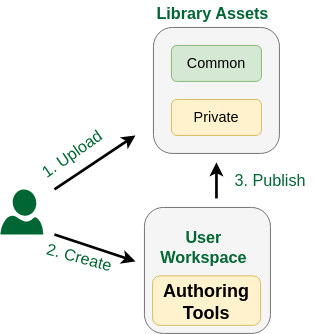 However, it is possible for users to take advantage of services
available in their workspace to install asset authoring tools
in their own workspace.
These authoring tools can then be used to create and publish new assets.
User workspaces are private and are not shared with other users.
Thus, any licensed software tools installed in a workspace are
only available to that user.
However, it is possible for users to take advantage of services
available in their workspace to install asset authoring tools
in their own workspace.
These authoring tools can then be used to create and publish new assets.
User workspaces are private and are not shared with other users.
Thus, any licensed software tools installed in a workspace are
only available to that user.
Digital Twin Models
Can the DTaaS platform create new DT models?
DTaaS is not a model creation tool. Model creation tools can be placed inside DTaaS to create new models. The DTaaS platform itself does not create digital twin models but can help users create digital twin models. Linux desktop/terminal tools can be run inside DTaaS. Thus, models can be created inside DTaaS and executed using tools that run on Linux. Windows-only tools cannot run in DTaaS.
How can the DTaaS platform help to design geometric model? Does it support 3D modeling and simulation?
Well, DTaaS by itself does not produce any models. DTaaS only provides a platform and an ecosystem of services to facilitate digital twins to be run as services. Since each user has a Linux OS at their disposal, they can also run digital twins that have graphical interface. In summary, the DTaaS platform is neither a modeling nor simulation tool. If you need these kinds of tools, you need to bring them onto the platform. For example, if you need Matlab for your work, you need to bring he licensed Matlab software.
Can the DTaaS platform support only the information models (or behavioral models) or some other kind of models?
The DTaaS platform as such is agnostic to the kind of models you use. DTaaS can run all kinds of models. This includes behavioral and data models. As long as you have models and the matching solvers that can run in Linux OS, you are good to go in DTaaS. In some cases, models and solvers (tools) are bundled together to form monolithic DTs. The DTaaS platform does not limit you from running such DTs as well. DTaaS does not provide dedicated solvers. But if you can install a solver in your workspace, then you don't need the platform to provide one.
Does it support XML-based representation and ontology representation?
Currently No. We are looking for users needing this capability. If you have concrete requirements and an example, we can discuss a way of realizing it in DTaaS.
Communication Between Physical Twin and Digital Twin
How can the DTaaS platform control the physical entity? Which technologies it uses for controlling the physical world?
At a very abstract level, there is a communication from physical entity to digital entity and back to physical entity. How this communication should happen is decided by the person designing the digital entity. The DTaaS can provide communication services that can help you do this communication with relative ease. You can use InfluxDB, RabbitMQ and Mosquitto services hosted on DTaaS for two communication between digital and physical entities.
How would you measure a physical entity like shape, size, weight, structure, chemical attributes etc. using DTaaS? Any specific technology used in this case?
The real measurements are done at physical twin which are then communicated to the digital twin. Any digital twin platform like DTaaS can only facilitate this communication of these measurements from physical twin. The DTaaS provides InfluxDB, RabbitMQ and Mosquitto services for this purpose. These three are probably most widely used services for digital twin communication. Having said that, DTaaS allows you to utilize other communication technologies and services hosted elsewhere on the Internet.
How can real-time data differ from static data and what is the procedure to identify dynamic data? Is there any UI or specific tool used here?
The DTaaS platform can not understand the static or dynamic nature of data. It can facilitate storing names, units and any other text description of interesting quantities (weight of batter, voltage output etc). It can also store the data being sent by the physical twin. The distinction between static and dynamic data needs to be made by the user. Only metadata of the data can reveal such more information about the nature of data. A tool can probably help in very specific cases, but you need metadata. If there is a human being making this distinction, then the need for metadata goes down but does not completely go away. In some of the DT platforms supported by manufacturers, there is a tight integration between data and model. In this case, the tool itself is taking care of the metadata. The DTaaS is a generic platform which can support execution of digital twins. If a tool can be executed on a Linux desktop / commandline, the tool can be supported within DTaaS. The tool (ex. Matlab) itself can take care of the metadata requirements.
Digital Twin DevOps Automation
Can a DT execute forever?
The web UI imposes a 10-minute timeout. The users can manually terminate an ongoing execution. The best choice would be for a DT to execute terminate script which consequently concludes the execution and returns the logs.
Is the DT execution really scalable?
This capacity of DT execution infrastructure is dependent on GitLab and the available compute power available to runners of GitLab. GitLab itself does not impose limits on the maximum number of runners.
I have many GitLab runners attached with my GitLab repository? Which one is used?
This is indeterminate. You can't rely on the order and location of execution for a DT.
Data Management
Can the DTaaS platform collect data directly from sensors?
Yes via platform services.
Does DTaaS support data collection from different sources like hardware, software and network? Is there any user interface or any tracking instruments used for data collection?
The DTaaS platform provids InfluxDB, PostgreSQL, RabbitMQ, MQTT, MongoDB and ThingsBoard services. Both the physical twin and digital twin can utilize these protocols for communication. The IoT (time-series) data can be collected using InfluxDB and MQTT broker services. There is a user interface for InfluxDB which can be used to analyze the data collected. Users can also manually upload their data files into the DTaaS.
Is the DTaaS platform able to transmit data to cloud in real time?
Yes via platform services.
Which transmission protocol does the DTaaS platform allow?
InfluxDB, RabbitMQ, MQTT and anything else that can be used from Cloud service providers.
Does the DTaaS platform support multisource information and combined multi sensor input data? Can it provide analysis and decision-supporting inferences?
You can store information from multiple sources. The existing InfluxDB services hosted on DTaaS already has a dedicated Influx / Flux query language for doing sensor fusion, analysis and inferences.
Which kinds of visualization technologies the DTaaS platform can support (e.g. graphical, geometry, image, VR/AR representation)?
Graphical, geometric and images. If you need specific licensed software for the visualization, you will have to bring the license for it. DTaaS does not support AR/VR.
Platform Native Services on the DTaaS Platform
Is the DTaaS platform able to detect the anomalies about-to-fail components and prescribe solutions?
This is the job of a digital twin. If you have a ready to use digital twin that does the job, DTaaS allows others to use your solution. It is possible to perform anomaly detection using the platform services such as Grafana, ThingsBoard and InfluxDB.
Comparison with other DT Platforms
All the DT platforms seem to provide different features. Is there a comparison chart?
Here is a qualitative comparison of different DT integration platforms:
Legend: high performance (H), mid performance (M) and low performance (L)
| DT Platforms | License | DT Development Process | Connectivity | Security | Processing power, performance and Scalability | Data Storage | Visualization | Modeling and Simulation |
|---|---|---|---|---|---|---|---|---|
| Microsoft Azure DT | Commercial Cloud | H | H | H | M | H | H | H |
| AWS IOT Greengrass | Open source commercial | H | H | H | M | H | H | H |
| Eclipse Ditto | Open source | M | H | M | H | H | L | L |
| Asset Administration Shell | Open source | H | H | L | H | M | L | M |
| PTC Thingworx | Commercial | H | H | H | H | H | M | M |
| GE Predix | Commercial | M | H | H | M | L | M | L |
| The DTaaS Platform | Open source | H | H | L | L | M | M | M |
1 2 3 4 5 6 | |
All the comparisons between DT platforms seems so confusing. Why?
The fundamental confusion comes from the fact that different DT platforms (Azure DT, GE Predix) provide different kind of DT capabilities. You can run all kinds of models natively in GE Predix. In fact you can run models even next to (on) PTs using GE Predix. But you cannot natively do that in Azure DT service. You have to do the leg work of integrating with other Azure services or third-party services to get the kind of capabilities that GE Predix natively provides in one interface. The takeaway is that we pick horses for the courses.
GDPR Concerns
Does your platform adhere to GDPR compliance standards? If so, how?
The DTaaS platform does not store any personal information of users. It only stores username to identify users and these usernames do not contain enough information to deduce the true identify of users.
Which security measures are deployed? How is data encrypted (if exists)?
The default installation requires a HTTPS terminating reverse proxy server from user to the DTaaS platform installation. The administrators of DTaaS platform can also install HTTPS certificates into the application. The codebase can generate HTTPS application and the users also have the option of installing their own certificates obtained from certification agencies such as LetsEncrypt.
What security measures does your cloud provider offer?
The the DTaaS platform can be installed inside corporate server hosted behind network firewalls so that only permitted user groups have access to the network and physical access to the server.
How is user access controlled and authenticated?
There is a two-level authorization mechanism in place in each default installation of the DTaaS. The first-level is HTTP basic authorization over secure HTTPS connection. The second-level is the OAuth 2.0 PKCE authorization flow for each user. The OAuth 2.0 authorization is provider by a GitLab instance. The DTaaS does not store the account and authorization information of users.
Does you platform manage personal data? How is data classified and tagged based on the sensitivity? Who has access to the critical data?
The platform does not store personal data of users.
How are identities and roles managed within the platform?
There are two roles for users on the platform. One is the administrator and the other one is user. The user roles are managed by the administrator.