Testing
 Fundamental Concepts in Software Testing
Definition of Software Testing
Software testing is a procedure to investigate the quality of a software product across different scenarios. It can also be defined as the process of verifying and validating that a software program or application works as expected and meets the business and technical requirements that guided its design and development.
Importance of Software Testing
Software testing is essential for identifying defects and errors introduced during different development phases. Testing also ensures that the product under test works as expected across expected scenarios — a stronger test suite results in greater confidence in the product being built. One important benefit of software testing is that it enables developers to make incremental changes to source code while ensuring that current changes do not break the functionality of previously existing code.
Test Driven Development (TDD)
Test Driven Development (TDD) is a software development process that relies on the repetition of a very short development cycle: first, the developer writes an (initially failing) automated test case that defines a desired improvement or new function, then produces the minimum amount of code to pass that test, and finally refactors the new code to acceptable standards. The goal of TDD can be viewed as specification rather than validation. In other words, TDD provides a methodology for thinking through requirements or design before writing functional code.
Behaviour Driven Development (BDD)
Behaviour Driven Development (BDD) is a software development process that emerged from TDD. It includes the practice of writing tests first, but focuses on tests that describe behavior rather than tests that verify a unit of implementation. This approach provides software development and management teams with shared tools and a shared process for collaborating on software development. BDD is largely facilitated through the use of a simple domain-specific language (DSL) employing natural language constructs (e.g., English-like sentences) that can express behavior and expected outcomes. Mocha and Cucumber testing libraries are built around the concepts of BDD.
 Testing Workflow
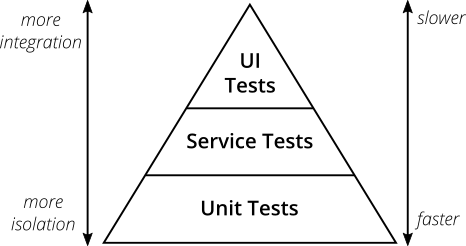
(Ref: Ham Vocke, The Practical Test Pyramid)
The DTaaS project follows a testing workflow in accordance with the test pyramid diagram shown above, starting with isolated tests and moving towards complete integration for any new feature changes. The different types of tests, in the order that they should be performed, are explained below:
Unit Tests
Unit testing is a level of software testing where individual units/ components of a software are tested. The objective of Unit Testing is to isolate a section of code and verify its correctness.
Ideally, each test case is independent from the others. Substitutes such as method stubs, mock objects, and spies can be used to assist testing a module in isolation.
Benefits of Unit Testing
- Unit testing increases confidence in changing and maintaining code. When good unit tests are written and executed every time code is changed, defects introduced due to the change can be promptly identified.
- When code is designed to be less interdependent to facilitate unit testing, the unintended impact of changes to any code is reduced.
- The cost, in terms of time, effort, and money, of fixing a defect detected during unit testing is lower compared to defects detected at higher levels.
Unit Tests in DTaaS
Each component of the DTaaS project uses a unique technology stack; therefore,
the packages used for unit tests differ across components. The test/
directory of each component contains information about the specific unit
test packages employed.
Integration Tests
Integration testing is the phase in software testing in which individual software modules are combined and tested as a group. The DTaaS project uses an integration server for software development as well as integration testing.
The existing integration tests are performed at the component level. Integration tests between components have not yet been implemented; this task has been deferred to future development.
End-to-End Tests
Testing code changes through the end-user interface of the software is essential to verify that the code produces the desired effect for users. End-to-End tests in DTaaS require a functional setup.
End-to-end testing capabilities in DTaaS are currently limited; further development of this testing layer has been deferred to future work.
Feature Tests
A software feature can be defined as changes made to the system to add new functionality or modify existing functionality. Each feature is characterized by being useful, intuitive, and effective. It is important to test new features upon implementation and to ensure that they do not break the functionality of existing features. Feature tests are therefore essential for maintaining software quality.
The DTaaS project does not currently include feature tests. Cucumber is planned for use in implementing feature tests in future development.
References
- Arthur Hicken, Shift left approach to software testing
- Justin Searls and Kevin Buchanan, Contributing Tests wiki.
- This wiki has good explanation of TDD and test doubles.