Heart Digital Twin
Overview
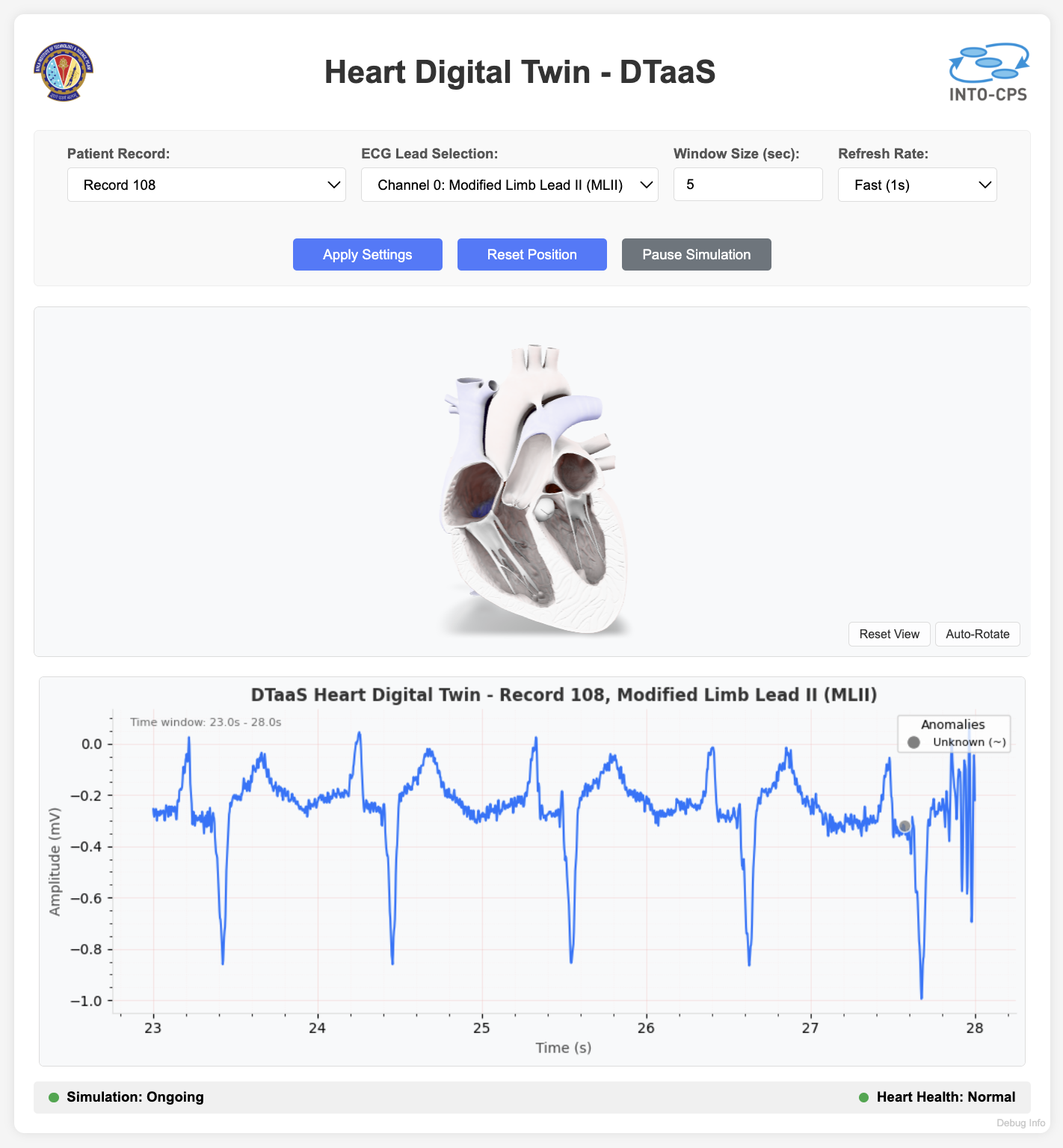
The Heart Digital Twin demonstrates a real-time cardiovascular monitoring system using ECG data from the MIT-BIH Arrhythmia Database. This digital twin provides live ECG visualisation with anomaly detection and features an interactive 3D heart model that synchronises with the cardiac rhythm, creating an immersive healthcare monitoring experience within the DTaaS platform.
Example Structure
The Heart Digital Twin consists of several key components working together:
- ECG Data Processing: Real-time processing and visualisation of electrocardiogram signals from the MIT-BIH database
- 3D Heart visualisation: Interactive 3D heart model with synchronised pumping animation
- Anomaly Detection: Real-time identification and highlighting of cardiac anomalies
- Web Interface: Flask-based web application for real-time monitoring and control
MIT-BIH Arrhythmia Database
This digital twin utilises the renowned MIT-BIH Arrhythmia Database, which contains 48 half-hour excerpts of two-channel ambulatory ECG recordings. The database includes:
- Records from 47 subjects studied by the BIH Arrhythmia Laboratory
- 360 Hz sampling frequency with 11-bit resolution
- Expert annotations for arrhythmia detection and classification
- Multiple ECG channels (MLII, V1, V2, V4, V5) depending on the record
Records 100-109 are available for simulation, each containing different types of cardiac rhythms and anomalies for comprehensive testing and demonstration.
Digital Twin Configuration
This example uses the following assets:
| Asset Type | Names of Assets | Visibility | Reuse in Other Examples |
|---|---|---|---|
| Data | MIT-BIH Arrhythmia Database Records (100-109) | Public | Yes |
| Models | 3D Heart Model (Beating heart.glb) | Public | Yes |
| Functions | ECG Processing & Anomaly Detection | Public | Yes |
| Tools | Flask Web Server & UI Components | Public | Yes |
The heart digital twin can be customised through various parameters:
- Record Selection: Choose from records 100-109
- Channel Selection: Switch between available ECG channels
- Window Size: Adjust the time window for real-time display
- Update Frequency: Control the refresh rate of the simulation
3D Heart Animation
The digital twin features a synchronised 3D heart pumping animation that enhances the monitoring experience:
- Real-time Synchronisation: Heart model animation matches the ECG rhythm
- Interactive Controls:
- Camera controls for 360° viewing
- Auto-rotate functionality
- Reset view option
- Animation Features:
- Realistic beating heart model
- Smooth cardiac cycle animation
- Pause/resume functionality synchronised with ECG simulation
- Model Format: High-quality GLB (GL Transmission Format Binary) 3D model
- Rendering: WebGL-based rendering using model-viewer component
The 3D heart provides visual feedback that correlates with the electrical activity shown in the ECG, making it easier to understand the relationship between electrical signals and mechanical heart function.
Lifecycle Phases
| Lifecycle Phase | Completed Tasks |
|---|---|
| Create | Sets up Python virtual environment and installs required dependencies (NumPy, Pandas, Matplotlib, WFDB, Flask) |
| Execute | Starts the Flask web server and launches the heart monitoring interface accessible via web browser |
| Clean | Terminates the running application and removes the virtual environment |
DevOps Automation
This example demonstrates the use of DevOps features of the DTaaS platform. GitLab DevOps pipelines are used to automate and manage its lifecycle.
Pipeline Configuration
The .gitlab-ci.yml file controls the sequence of lifecycle script executions
for the heart digital twin. It defines multiple stages:
- create: Sets up the Python virtual environment and installs dependencies
- execute: Runs the heart digital twin application
Runner Requirements
Important: This digital twin requires a shell-based GitLab runner, not a Docker-based runner. The application needs:
- Access to the host system's Python environment
- Ability to create and manage Python virtual environments
- File system access for model loading and data processing
- Network access for the web application
Docker-based runners may restrict network or filesystem access critical to this digital twin.
Alternative Execution Mode: Docker
There is also an option to use Docker-based execution for the heart digital twin — while still using a shell-based GitLab runner.
The corresponding GitLab CI file for this approach is gitlab-ci-docker.yml
To enable this alternative execution path, the root .gitlab-ci.yml must be
modified to reference this Docker-based pipeline (gitlab-ci-docker.yml)
instead of the default one.
Artifacts and Outputs
This example produces:
- Heart simulation outputs
- Web application logs
These are saved as artefacts in the GitLab pipeline. The virtual environment
created in the create stage is also preserved as an artefact for reuse in the
execute stage.
Run the example
To run the example, navigate to the following directory:
If required, change the execute permission of the lifecycle scripts to be executed:
Now, run the following scripts:
Create
Sets up the Python environment and installs all required dependencies including WFDB for MIT-BIH data access, Flask for the web interface, and scientific computing libraries.
Execute
Launches the Heart Digital Twin web application. The server will start and be accessible via web browser for real-time ECG monitoring and 3D heart visualisation.
The application will be available at http://localhost:5001 and will
automatically:
- Load required MIT-BIH records
- Initialise the ECG data processing
- Start real-time visualisation
- Enable 3D heart model Synchronisation
Examine the results
Access the web interface to:
- Monitor Real-time ECG: View live electrocardiogram signals
- Control Simulation: Select different records, channels, and update frequencies
- Interact with 3D Heart: Rotate, zoom, and control the heart animation
- Detect Anomalies: Observe highlighted cardiac irregularities
- Pause/Resume: Control the simulation flow
Application logs can be found in the logs/heart_dt.log file for debugging and
monitoring purposes.
Clean
Terminates the running application and cleans up the environment.
This will:
- Stop the Flask web server
- Remove the Python virtual environment
- Clean up any temporary files
References
More information about the MIT-BIH Arrhythmia Database and cardiac monitoring:
The MIT-BIH Arrhythmia Database is available at: https://physionet.org/content/mitdb/