Testing
Fundamental Concepts in Software Testing
Definition of Software Testing
Software testing investigates the quality of a software product across different scenarios. It can also be defined as the process of verifying and validating that a program works as expected and meets the business and technical requirements that guided its design and development.
Importance of Software Testing
Testing finds defects introduced during the different development phases and checks that the product works as expected in the expected scenarios. A stronger test suite gives more confidence in the product. Tests also let developers make incremental changes to the source code and check that those changes do not break existing functionality.
Test Driven Development (TDD)
Test Driven Development (TDD) is a development process built on repeating a very short cycle. The developer first writes an automated test case, which initially fails, that defines a desired improvement or new function. They then write the minimum code needed to pass that test, and finally refactor the new code to acceptable standards. TDD is closer to specification than to validation: it gives a method for thinking through requirements or design before writing functional code.
Behaviour Driven Development (BDD)
Behaviour Driven Development (BDD) grew out of TDD. It keeps the practice of writing tests first, but its tests describe behaviour instead of verifying a unit of implementation. Development and management teams get a shared set of tools and a shared process for working together. BDD usually relies on a simple domain-specific language (DSL) with natural language constructs (e.g., English-like sentences) that express behaviour and expected outcomes. The Mocha and Cucumber testing libraries are built around BDD.
Testing Workflow
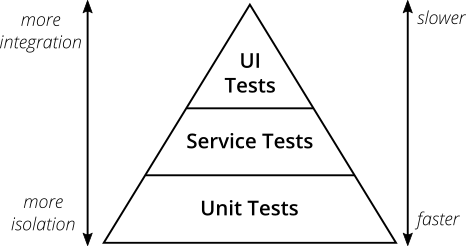
(Ref: Ham Vocke, The Practical Test Pyramid)
The DTaaS project follows the test pyramid shown above. Testing of a new feature starts with isolated tests and moves towards full integration. The types of tests are explained below, in the order in which they should be performed.
Unit Tests
Unit testing tests the individual units or components of a piece of software. Its aim is to isolate a section of code and verify that it is correct.
Ideally, each test case is independent of the others. Substitutes such as method stubs, mock objects and spies help test a module in isolation.
Benefits of Unit Testing
- Unit tests increase confidence when changing and maintaining code. When good unit tests run every time the code changes, defects introduced by the change are found quickly.
- Code designed with fewer interdependencies, to make unit testing easier, suffers fewer unintended effects from changes.
- Fixing a defect found during unit testing costs less time, effort and money than fixing one found at a higher level.
Unit Tests in DTaaS
Each DTaaS component uses its own technology stack, so the unit test
packages differ between components. The client uses Jest and React Testing
Library, and the NestJS servers use Jest. The Python CLIs and libraries use
pytest. The build and test command for each project is listed in
PROJECT.md in the repository root.
Integration Tests
Integration testing combines individual software modules and tests them as a group. The DTaaS project uses an integration server for both software development and integration testing.
The existing integration tests work at the component level. Integration tests between components have not been implemented yet and are deferred to future work.
End-to-End Tests
Testing code changes through the end-user interface shows whether the code has the intended effect for users. End-to-End tests in DTaaS require a working setup.
The client has end-to-end tests written with Playwright. The library
microservice, the runner and the logger microservice have end-to-end tests
run with Jest (yarn test:e2e).
Feature Tests
A software feature is a change to the system that adds new functionality or modifies existing functionality. New features should be tested when they are implemented, along with checks that they do not break existing features.
The DTaaS project does not have feature tests yet. Cucumber is planned for implementing them.
References
- Arthur Hicken, Shift left approach to software testing
- Justin Searls and Kevin Buchanan, Contributing Tests wiki.
- This wiki has a good explanation of TDD and test doubles.