Client Extensions
The web client uses npm packages for parts of its behaviour, and some of these packages are maintained outside this repository. This page lists them, describes how the Building Models page is wired into the client, and summarises the modular architecture proposed for domain-specific pages.
Packages Used by the Client
| Package | Source | Role in the client |
|---|---|---|
@into-cps-association/dt-automation |
lib/dt-automation/ in this repository |
Data, state and GitLab operations for creating, managing and executing DTs. The client takes it from npm (^0.2.0 in client/package.json). |
@into-cps-association/bim-kit |
ifc-utils | IFC to glTF conversion in the browser, the binding manifest and the viewer of the Building Models page. The client pins version 0.1.1. |
The client page describes the classes of
dt-automation, and Publish Packages
describes how it is released.
The Building Models Page
The domain logic of the Building Models page lives in bim-kit. The
client holds three wiring files in client/src/route/bim/:
Bim.tsxplaces the page in the DTaaS layout and hands the viewer the library URL of the signed-in user.library.tsnames the folder that holds the models,common/models.persistGeometry.tswrites a model converted in the browser back to the library, so that each model is converted once.
A change to how a model is drawn reaches DTaaS as a new version of
bim-kit. The page is still wired into the client by hand, in the route
table (src/routes.tsx), the menu (src/page/MenuItems.tsx), the icon
registry (src/components/appIcons.tsx) and package.json. A page for
another domain would have to edit the same files.
Proposed Modular Architecture
The modular architecture described here is a proposal. It is not merged
into the client, and client/package.json does not depend on the SDK.
The dtaas-sdk
repository holds @into-cps-association/dtaas-sdk, which defines a
contract between the web client (the host) and domain extensions. In the
proposal:
- A domain extension is an npm package. It declares what it contributes,
such as pages, navigation entries, digital twin tabs, asset previews,
anchor kinds, converters, encoding presets and substrates, as one
DtaasExtensionobject. - The host passes platform services to each extension through a
HostServicesobject: authentication, the library, the workspace contents API, GitLab, live signals, the visualisation service, user interface helpers, logging, settings and configuration. An extension does not import client internals. - The client lists the extensions compiled into a build in one file,
src/extensions.ts. A deployment can disable a compiled-in extension inenv.jswithREACT_APP_EXTENSIONS_DISABLED. - A common visualisation core,
dtaas-visualisation, holds the parts that do not depend on the domain: live data transport, the temporal store, anchor resolution, encoding rules and the standard substrates. bim-kitis moved onto the contract, and the wiring files inclient/src/route/bim/move into it.
The SDK declares a contract revision (sdk: 1) that is separate from its npm
version, and a host built on the SDK refuses an extension built for another
revision. The examples/bim folder of the SDK repository ports bim-kit 0.1.1
onto the contract as a private package.
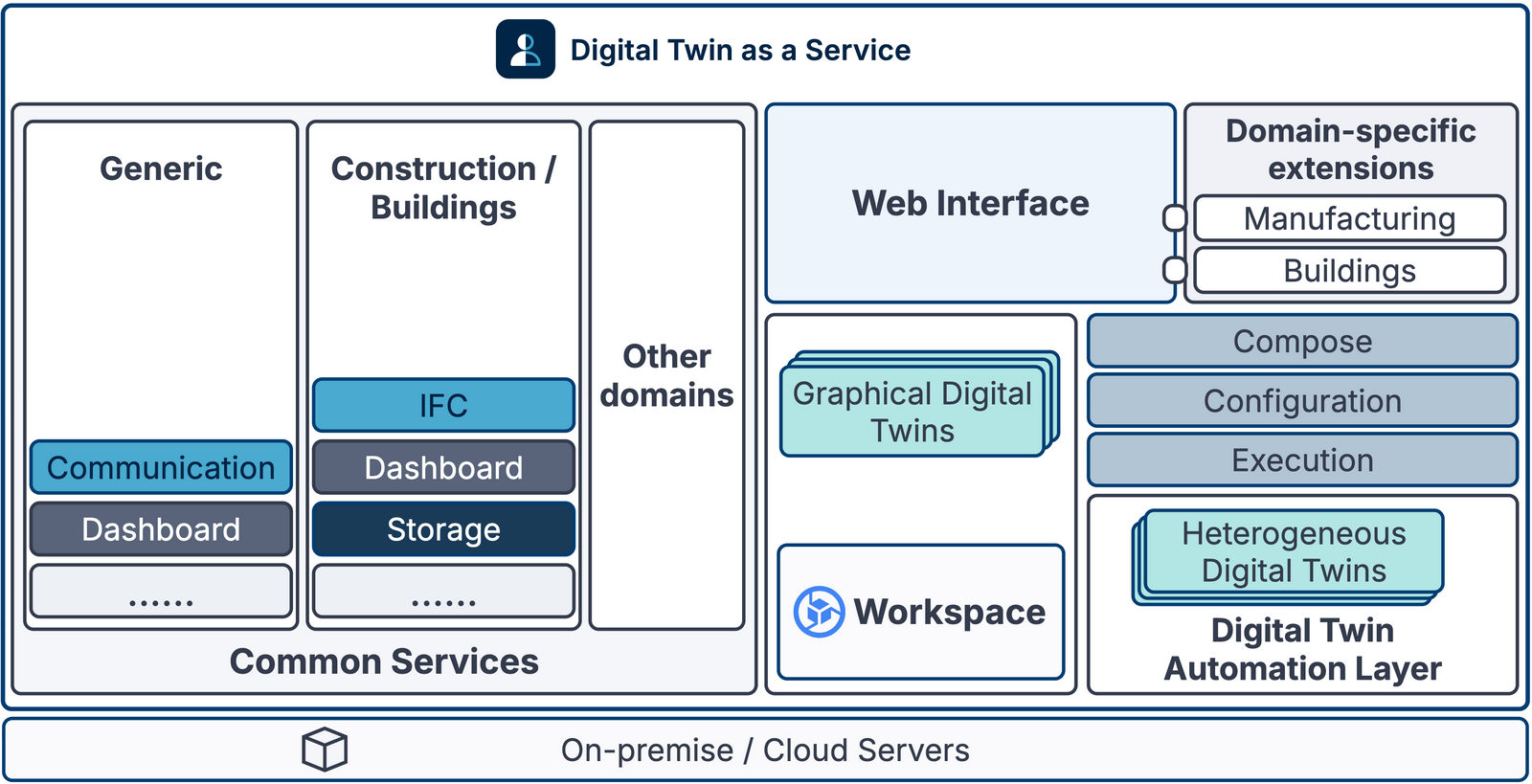
The figure shows the direction of this architecture. Domain-specific extensions add pages to the web interface, and the common services are grouped into a generic set and a set for each domain, such as IFC for construction and buildings. Of the two extensions drawn, the Buildings page exists in the client today, as a hand-wired route.
The SDK repository documents the proposal in detail: