System Design of DTaaS Authorization Microservice
DTaaS needs backend authorization to protect its backend services and user workspaces. This page describes the system design of the DTaaS Auth Microservice, which provides it.
Requirements
The Auth MS only has to answer requests of the general form "Is User X allowed to access /BackendMS/example?".
If the GitLab OAuth 2.0 provider verifies the user's identity AND the user is allowed to access the requested microservice or action, the Auth MS responds with a 200 (OK) code and lets the request pass through the gateway to the microservice or server.
If identity verification through GitLab OAuth 2.0 fails OR the user is not permitted to access the requested resource, the Auth MS responds with a 40X (NOT OK) code and stops the request.
Forward Auth Middleware in Traefik
Traefik lets you attach middlewares to the routes configured in it. A middleware intercepts requests on a route and can analyse or modify them before passing them on to the services. Traefik's ForwardAuth middleware delegates authentication to an external service. If the external authentication server responds with a 2XX code, the middleware acts as a proxy and lets the request through to the service. If the external server responds with any other code, the middleware drops the request and returns that response code to the user.
 (source:
Traefik documentation)
An Auth Microservice can therefore be added to the existing gateway and DTaaS system by making it the external authentication server for ForwardAuth middlewares. These middlewares can be attached to any route that needs authentication. DTaaS attaches it to all routes, because the platform requires at least identity verification for every request through the gateway.
Auth MS Design
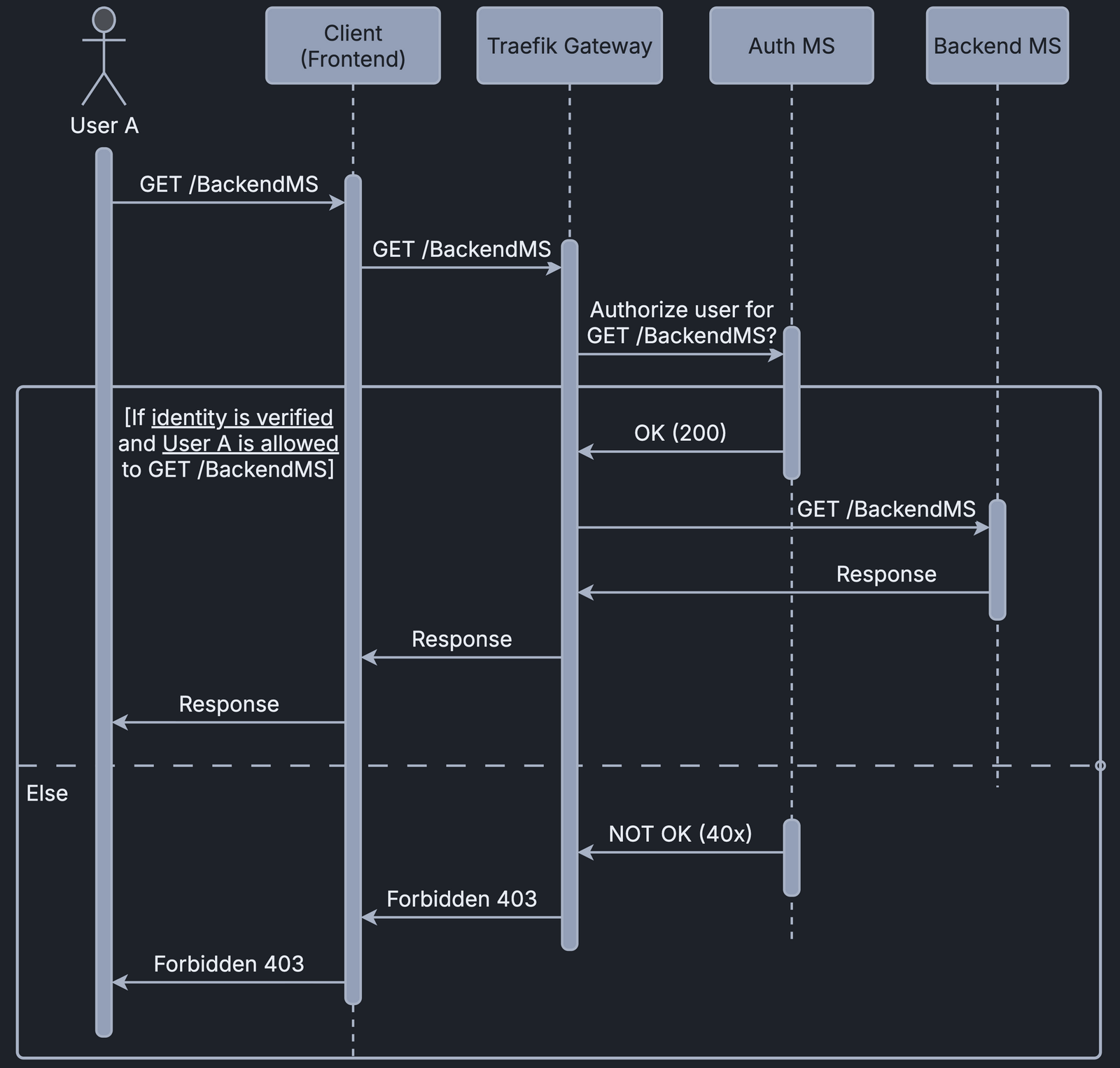
The sequence diagram shows how the integrated Auth MS works.

-
The user makes every request through the React website, the frontend of the DTaaS platform.
-
The request goes through the Traefik gateway, where the route's ForwardAuth middleware intercepts it.
-
The middleware asks the Auth MS whether this request from this user should be allowed.
-
The Auth MS (the auth server) verifies the user's identity using OAuth 2.0 with GitLab, and checks whether the user may make this request.
-
If the user is verified and allowed to make the request, the auth server responds with 200 OK to the Traefik gateway (more precisely, to the middleware in Traefik).
-
Traefik then forwards the request to the service. Any response from the service passes back along the chain to the user.
-
If the user is not verified or not allowed to make the request, the auth server responds with a 40X code to the Traefik gateway.
-
Traefik then drops the request and tells the client that the request was forbidden, passing on the auth server's response code.